
Healing Properties
Topazite – Imperial Topaz, Quartz, and Biotite
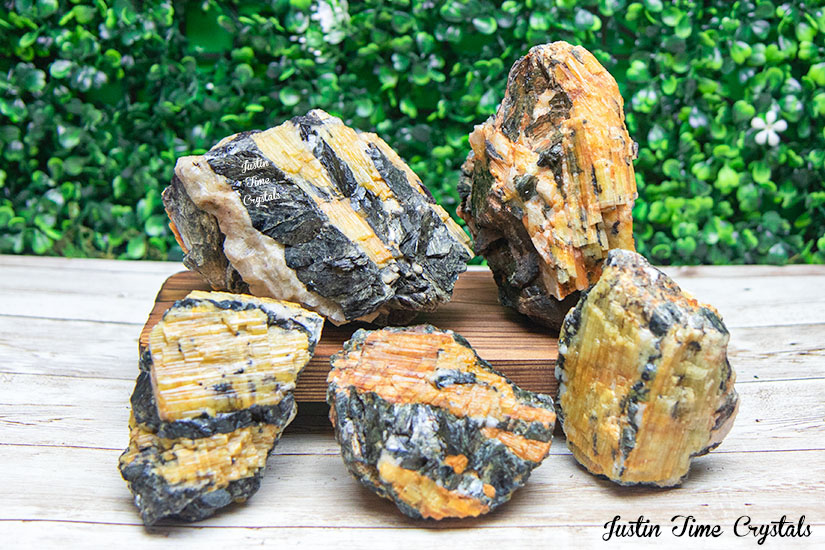
Topazite – The Radiant Union of Fire, Clarity, and Earth.
Topazite is a newly identified and uniquely captivating mineral combination that harmoniously blends three powerful elements: Imperial Topaz, Quartz, and Biotite. Mined exclusively in the mineral-rich regions of Brazil, this stone is prized not only for its exceptional visual beauty but also for its dynamic energetic properties.
Topazite is a trade name used by Justin Time Crystals to describe a beautiful golden to honey-colored gemstone material that is typically composed of a combination of minerals, most notably Imperial Topaz, Quartz, and Biotite. Though not a distinct mineral species recognized by the International Mineralogical Association (IMA), Topazite is valued in the gem and metaphysical markets for its radiant golden hues and energetic properties.
Often found in Brazil, Topazite is popular among collectors, jewelry designers, and spiritual practitioners. Its vivid colors and natural shimmer are reminiscent of Imperial Topaz, but its composition and visual complexity set it apart.
Composition and Properties
Topazite showcases shimmering hues ranging from golden yellow to champagne and peach—courtesy of Imperial Topaz, its most prominent feature. These vibrant inclusions are naturally embedded within a translucent to milky Quartz matrix, often accompanied by speckles or layers of Biotite, a dark, mica-based mineral that adds both visual contrast and grounding energy.
Each specimen of Topazite presents a natural interplay of fire and earth, with golden flashes of Topaz dancing within the crystalline embrace of Quartz, all grounded by Biotite’s dark, reflective layers.
Primary Components:
- Imperial Topaz (Al₂SiO₄(F,OH)₂)
- Quartz (SiO₂)
- Biotite (K(Mg,Fe)₃AlSi₃O₁₀(F,OH)₂)
Color: Ranges from golden yellow, honey, amber, to light brown; may have shimmery or glassy inclusions
Luster: Vitreous (glassy) to silky, depending on mineral content and polish
Transparency: Transparent to translucent
Hardness:Varies based on dominant mineral, typically:
Topaz: 8 on Mohs scale
Quartz: 7
Biotite: 2.5–3
Crystal System: Orthorhombic (Topaz), Trigonal (Quartz), Monoclinic (Biotite)
Specific Gravity: ~3.4 to 3.6 depending on mineral proportions
Physical Properties
Topazite is not a singular mineral species but rather a natural composite material typically consisting of Imperial Topaz, Quartz, and Biotite. Because of this, its physical properties vary slightly depending on the dominant mineral content in each specimen.
Formation and Locations
Topazite forms in granite pegmatites and hydrothermal veins, where high temperatures and pressures allow for the growth of topaz, quartz, and mica minerals. It is commonly mined in regions rich in Imperial Topaz and other silica-based minerals.
Primary locality:
Minas Gerais, Brazil – the most notable source of Imperial Topaz and Topazite material
Other potential (but rare) sources may include:
Pakistan
Russia
United States (Colorado)
However, most Topazite on the market comes from Brazil.
Historical and Cultural Significance
While Topazite as a trade name is relatively recent, its key mineral component—Imperial Topaz—has a long history of admiration, particularly in Brazil, where it has been called the “stone of the sun.” Topazite inherits this legacy and is often associated with solar energy, abundance, and vitality.
Uses and Applications
Jewelry:
Used in rings, pendants, and earrings; its hardness and clarity (when topaz-dominant) make it suitable for daily wear with careCollecting:
Attractive for mineral collectors due to its brilliant color and mixed mineral compositionMetaphysical Practices:
Popular for energy work, crystal healing, and chakra balancing
Metaphysical Properties and Healing Uses
Topazite is highly regarded in metaphysical circles for its energizing and abundance-attracting qualities, drawing on the synergy of its component minerals:
Believed energetic benefits:
Confidence & Personal Power:
The Imperial Topaz component is said to boost motivation, willpower, and charisma.Mental Clarity & Focus:
Quartz amplifies energy and thoughts, making Topazite a stone for clear intention and manifestation.Grounding & Protection:
Biotite adds a stabilizing energy, shielding against negativity and mental fatigue.Chakra Associations:
Solar Plexus Chakra: Empowerment, personal strength
Crown Chakra: Spiritual guidance and higher insight (quartz influence)
Care and Maintenance
Topazite’s care depends on its mineral makeup. While Topaz and Quartz are relatively hard, Biotite is soft and flaky, making the stone somewhat delicate overall.
Tips:
Avoid ultrasonic and steam cleaners
Clean with a soft cloth and mild soap
Store separately to prevent scratching softer minerals
Avoid harsh temperature changes
Conclusion
Due to its uncommon composition and limited geographic origin, Topazite is considered a rare collector’s stone. Its unique mineral trio makes it a standout in any curated collection, metaphysical toolkit, or display shelf.
Topazite is a dazzling and dynamic gemstone material that blends beauty, strength, and metaphysical depth. Whether you’re a crystal collector, a spiritual practitioner, or a jewelry lover, Topazite offers a radiant presence with warm energy and visual intrigue. By understanding its origins, properties, and care, you can make the most of this sunny and empowering stone.